1.
MacCallum claims that the distinction made between these two types of freedom has never been made sufficiently clear.
Controversy of discussions of absence/presence of freedom in societies comes in four kinds;
1) about the nature of freedom itself
2) about the relationships holding between the attainment of freedom and attainment of other possible social benefits
3) about freedom's ranking among such benefits
4) about the consequence of policies in relation to freedom
Freedom is generally considered a benefit, but it is not the only benefit to society. Recognising this can mean other benefits may at times outweigh freedom.
Disputes about the nature of freedom can be understood as a series of attempts by parties opposing each other to capture for their own side favourable attitudes attaching to the notion of freedom. This is Machiavellian, but disputes about the nature of freedom can also be genuinely put down to confusion.
2.
Whenever freedom of an agent is discussed, it means freedom from constraint, restriction, barrier, not doing, becoming or not becoming something;
(x is free from y to do z) (x ranges over agents, y ranges over preventing conditions, z ranges over actions or conditions of character or circumstance). This declaration shows that freedom is a triadic relationship.
Although this relationship doesn't require a human x, it must require something that relates to or is beneficial to humans e.g. free beer, free will, free society; implicit references to owners/consumers
There are also cases where it is not clear what corresponds to the second term. For example, social pressures can prevent one from action, as argued in Mill's On Liberty. It is possible to make the relationship dyadic, by saying Smith is free to leave the country because there are no legal restrictions on him leaving, rather than Smith is free from legal restrictions on travel to leave the country. The former excludes y. However, this should be considered illusory, because there may be other things preventing Smith from leaving.
In cases where it is not clear what corresponds to the third term, one should look at a term figuratively, or at least not concerned with anyone's specific freedom. One could also view something like freedom from hunger; seeing hunger as a barrier. One can also treat this expression in relation to Rooseveltian rhetoric; someone may be on a diet and therefore seek hunger, someone may be on a Ghandi-style hunger strike and actively seek it. Roosevelt wanted a world free of the barrier of hunger, but not one that would prevent the two former examples from achieving their goal; they wouldn't want people to be a victim of hunger they do not sink. This example is triadic. In other idioms, the third term isn't always clear; does freedom of religion entail freedom not to worship. Such issues raise historical doubt, rather than any issue with the third term.
The failing of negative and positive freedom is seeing freedom as a dyadic relation; either freedom from or freedom to. This doesn't do enough to distinguish; only serves to emphasise one or the other of two features of every case of the freedom of agents. Freedom is always freedom from something and freedom to do something (see freedom of religion argument).
3.
The ranges of the variables x y and z can be clarified to illuminate the differences between thinkers. However the distinction between positive and negative freedom stands in the way of this; it suggests that differences in accounts of freedom stem from differences in concept. The issue is that it is the concept of freedom that has been made a political issue, rather than what constitues a person, an obstacle and freedom itself.
Negative and positive freedom distorts important views of freedom by separating thinkers into two separate camps and thus diluting the value and importance of an analytical, philosophical account of freedom. They are too convoluted to fit into the neat x y z variables
The position one should adopt is to say that all thinkers have the same concept of freedom and from here go on to question what can serve as an agent, an obstacle and action/state/character of freedom
4.
This approach to freedom has been overlooked because philosophers have tried to answer the question "when are men free?" which invites misunderstanding by implying people can be free or not free. Being free, with no barriers, cannot be possible because it is so simplified; societal pressures prevent this.
There is a cornucopia of factors to consider when regarding somebody as free; a man who has the legal freedom to have a family doesn't necessarily have the economic freedom - saying he is free to raise a family entails misunderstandings.
Only when such factors are determined will we make about to make rational judgements about the merit of socieities with regard to freedom
5.
If Smith is freed to do d by means of c, as a result of being restricted from doing b by means of a, he is free to do d, but not what he was previously capable of doing; b. This issue conflicts with the problem of persons being either free or not free simply.
The importance of a restriction or freedom decide whether it is worth having/opposing
Monday, 15 February 2016

Thursday, 11 February 2016
Week 1 (2): Two Concepts of Liberty - Isaiah Berlin
The Notion of Negative Freedom
Political liberty is the area in which a man can act unobstructed by others. This is coercion in the sense that human beings have prevented someone from doing something they would otherwise have been able to do(e.g. not jumping 10 ft in the air);
"You lack liberty or freedom only if you are prevented from attaining a goal by human beings. Mere incapacity to attain a goal is not lack of political freedom"
If I am deprived of economic freedom due to my lack of mental/physical capacity, I describe this as being deprived of freedom. However if there are insitutions which prevent me from ahcieving economic freedom, I am a victim of economic slavery.
Classical English political philosophers believed man's interests were not wholly symbiotic, therefore chaos would ensue in a state of nature. However, libertarians such as Locke and Mill believed in a minimum personal area of freedom which must under no circumstances be violated
Philosophers with optimistic views of human nature (Locke, Smith, Mill) believed social harmony and progress were compatible with a large area of private life which the state or authority could not regulate. Even Hobbes believes that humans should have some form of freedom outside of social control. Benjamin Constant (in reference to Jacobin dictatorship) believed liberty of religion, expression and property should be safeguarded. Constant believed a minimum area of personal freedom was required to not 'degrade or deny our nature'.
Lasalle thought the state should be reduced to the role of nightwatchman/policeman
3 main points of negative freedom
Mill argued that truth can only be found in a condition of freedom. However, there are notable examples of eccentrics coming out of severely disciplined communities e.g. under military rule
This individualism and privatism came from the restoration and Renaissance; this was a paradigmatic shift
This form of liberty is incompatible with the absence of self-government: liberty is principally concerned with the area of control, not it's source
The Notion of Positive Freedom
Being one's own master.
The real self is considered to be something larger than the individual and this real self can only be created by a social whole which the individual is a part of; 'higher freedom': it is possible to coerce others for their own sake, to remove them from ignorance. People can choose things for us on the grounds that we should do so subconsciously as a rational self. Collective identity is a super personal identity
Issue polarizes over hedonism and the real mans wishes, according to those supporters of positive freedom
Rationality is underlined by solidarity - a like freedom for all; "rational mean will respect the principle of reason in one another"
"if the universe is governed by reason, there will be no need for coercion"
Spinoza claims that children aren't slaves because they are only coerced with respect to their own development
"the subject of a true commonwealth is no slave, because the common interests must include his own"
Such thinkers as Mill, Montesquei and Burke believe our rational ends must coincide
Rosseau "in giving myself to all, i give myself to none"
Education, says Fichte, must inevitably work in such a way that 'you will later recognise the reasons for what I am doing now'.
Political liberty is the area in which a man can act unobstructed by others. This is coercion in the sense that human beings have prevented someone from doing something they would otherwise have been able to do(e.g. not jumping 10 ft in the air);
"You lack liberty or freedom only if you are prevented from attaining a goal by human beings. Mere incapacity to attain a goal is not lack of political freedom"
If I am deprived of economic freedom due to my lack of mental/physical capacity, I describe this as being deprived of freedom. However if there are insitutions which prevent me from ahcieving economic freedom, I am a victim of economic slavery.
Classical English political philosophers believed man's interests were not wholly symbiotic, therefore chaos would ensue in a state of nature. However, libertarians such as Locke and Mill believed in a minimum personal area of freedom which must under no circumstances be violated
Philosophers with optimistic views of human nature (Locke, Smith, Mill) believed social harmony and progress were compatible with a large area of private life which the state or authority could not regulate. Even Hobbes believes that humans should have some form of freedom outside of social control. Benjamin Constant (in reference to Jacobin dictatorship) believed liberty of religion, expression and property should be safeguarded. Constant believed a minimum area of personal freedom was required to not 'degrade or deny our nature'.
Lasalle thought the state should be reduced to the role of nightwatchman/policeman
3 main points of negative freedom
Mill argued that truth can only be found in a condition of freedom. However, there are notable examples of eccentrics coming out of severely disciplined communities e.g. under military rule
This individualism and privatism came from the restoration and Renaissance; this was a paradigmatic shift
This form of liberty is incompatible with the absence of self-government: liberty is principally concerned with the area of control, not it's source
The Notion of Positive Freedom
Being one's own master.
The real self is considered to be something larger than the individual and this real self can only be created by a social whole which the individual is a part of; 'higher freedom': it is possible to coerce others for their own sake, to remove them from ignorance. People can choose things for us on the grounds that we should do so subconsciously as a rational self. Collective identity is a super personal identity
Issue polarizes over hedonism and the real mans wishes, according to those supporters of positive freedom
Rationality is underlined by solidarity - a like freedom for all; "rational mean will respect the principle of reason in one another"
"if the universe is governed by reason, there will be no need for coercion"
Spinoza claims that children aren't slaves because they are only coerced with respect to their own development
"the subject of a true commonwealth is no slave, because the common interests must include his own"
Such thinkers as Mill, Montesquei and Burke believe our rational ends must coincide
Rosseau "in giving myself to all, i give myself to none"
Education, says Fichte, must inevitably work in such a way that 'you will later recognise the reasons for what I am doing now'.
Tuesday, 9 February 2016
Week 1: What Is Political Philosophy?
David Miller, Political Philosophy: A Very Short Introduction, chapter 1.
Lorenzetti's Allegory of Good & Bad government expresses 3 ideas at the heart of politcal philosophy
1) Quality of government affects the lives of the governed: people who disagree with this will likely belong to centre left/centre right societies, not dictatorships where the quality of government evidently affected the lives of the governed.
2) Form government takes is not predetermined (social contract argument): the failings of hard determinism meant people had big choices to make in terms of what type of government they desired
3) We can distinguish between good and bad government therefore political knowledge exists: 21st C fatalism which led all societies were propelled by economic forces to govern themselves in a similar way made it difficult to distinguish between good and bad government
_-_WGA13487.jpg)
Political Philosophers
When political philosophers have directly intervened in political life, they have often failed: Hobbes' Leviathan argued for absolute government, but was rejected by both the Royalists and Parliamentarians. The reason behind their failure is supposedly their philosophical insight which challenges conventions and the reasoning behind them.
Societies require political philosophy to formulate responses to political challenges that cannot be dealt with using conventional wisdom.
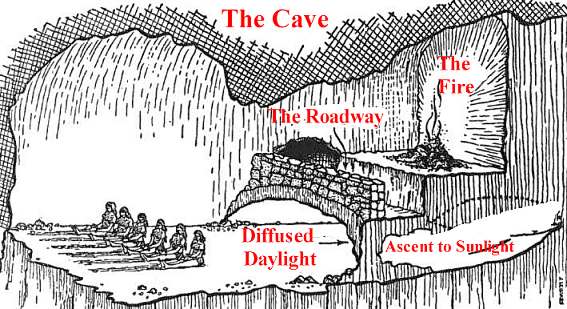
Some believe their role is similar to the freed man in Plato's analogy of The Cave. David Miller thinks that political philosophers are more reasonable and critical thinkers, merely reflective than possessing esoteric knowledge.
Lorenzetti's Allegory of Good & Bad government expresses 3 ideas at the heart of politcal philosophy
1) Quality of government affects the lives of the governed: people who disagree with this will likely belong to centre left/centre right societies, not dictatorships where the quality of government evidently affected the lives of the governed.
2) Form government takes is not predetermined (social contract argument): the failings of hard determinism meant people had big choices to make in terms of what type of government they desired
3) We can distinguish between good and bad government therefore political knowledge exists: 21st C fatalism which led all societies were propelled by economic forces to govern themselves in a similar way made it difficult to distinguish between good and bad government
Political Philosophers
When political philosophers have directly intervened in political life, they have often failed: Hobbes' Leviathan argued for absolute government, but was rejected by both the Royalists and Parliamentarians. The reason behind their failure is supposedly their philosophical insight which challenges conventions and the reasoning behind them.
Societies require political philosophy to formulate responses to political challenges that cannot be dealt with using conventional wisdom.
Some believe their role is similar to the freed man in Plato's analogy of The Cave. David Miller thinks that political philosophers are more reasonable and critical thinkers, merely reflective than possessing esoteric knowledge.
Subscribe to:
Comments (Atom)